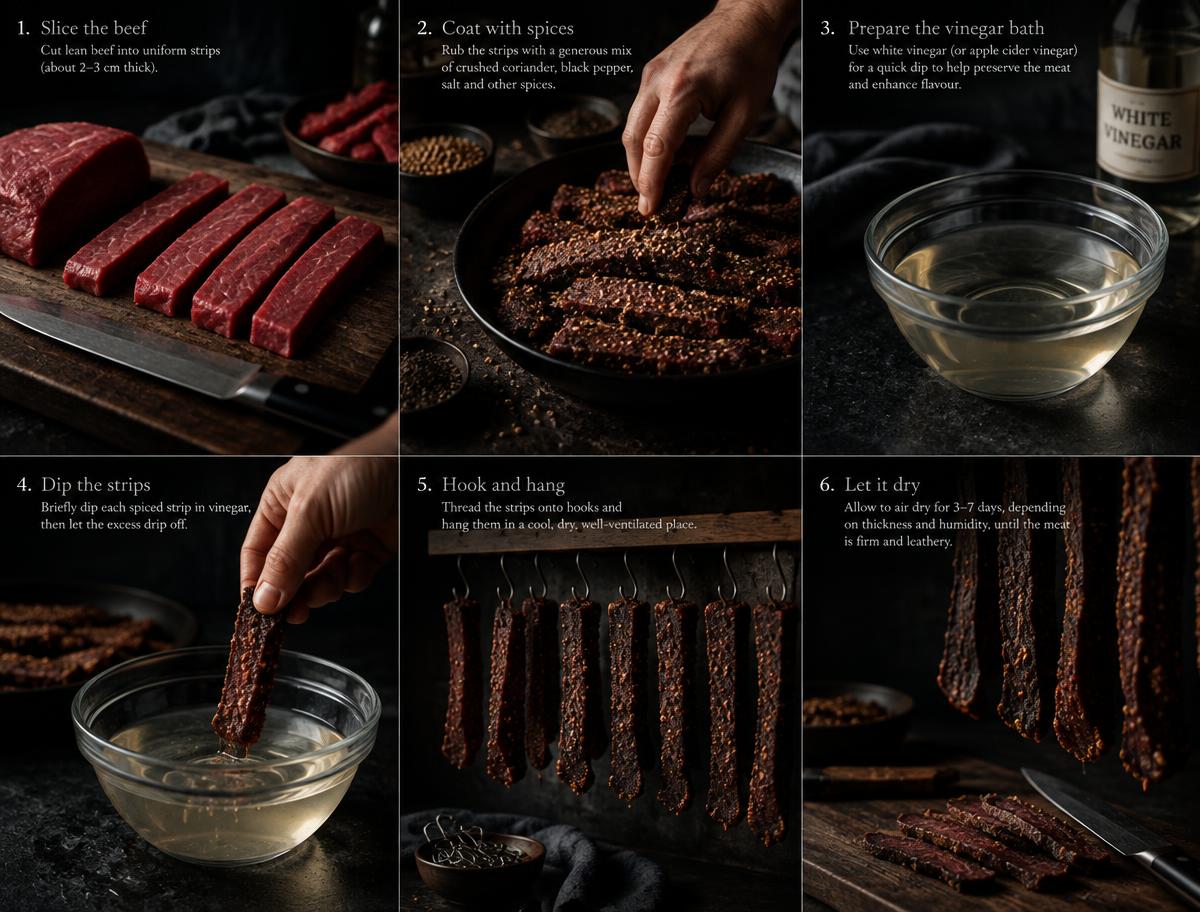
Biltong is air-dried, not cooked. Get four variables right — the cut, the salt, the acid and the airflow — and the rest is patience. This guide walks through each one, with the numbers that actually matter.
How to Make Biltong at Home: The Complete Guide
Cuts, salt, vinegar, spice, airflow and timing — everything that decides whether your first batch works.
- Prep
- 30 minutes
- Time
- 4-5 days
- Total
- 5 days
- Yield
- One 2.5 kg batch
What you need
What you need
- A lean, grainy cut: silverside, topside or rump
- Coarse rock salt — never table salt
- Brown spirit vinegar
- Whole coriander seed and black pepper
- A drying box with a fan and airflow
- Stainless hooks or biltong clips
Steps
- 1
Choose the cut. Silverside slices into long, even strips with the grain and has almost no internal sinew.
- 2
Cut with the grain, 2 cm thick. Thicker strips need days longer; thinner ones turn into crisps.
- 3
Salt for roughly one hour per batch, then shake the excess off. Salt draws out surface moisture and protects the meat during the first vulnerable day.
- 4
Add acid. Brown vinegar lowers the surface pH so bacteria and mould cannot establish. Wet every face of every strip.
- 5
Spice generously with toasted, cracked coriander and black pepper.
- 6
Hang with space. Strips must never touch, and air must move past every surface.
- 7
Hold 25-30 C with moving air. Higher temperatures case-harden the meat; lower temperatures invite mould.
- 8
Test from day 3. Firm with a slight give is medium. No give at all is dry.
- 9
Store in paper or a breathable cloth bag. Sealed plastic sweats and grows mould.
Tips from the box
- • If your kitchen is humid, run a dehumidifier in the same room as the box.
- • White powder on the surface is usually salt crystallising. Fuzzy green or black is mould — discard that strip.
Frequently asked questions
Do I need to cook biltong?
No. Biltong is cured and air-dried. The salt and vinegar plus steady airflow make it safe without any heat.
What temperature should a biltong box be?
Between 25 and 30 C with constant airflow. Above 35 C the outside seals before the inside dries.
Why did my biltong grow mould?
Almost always too little airflow, strips touching each other, or high humidity. Increase fan speed, space the strips and use enough vinegar.